
Framing your professional experience
Showing companies you're the right designer for the role (even in our f*cked up job market)
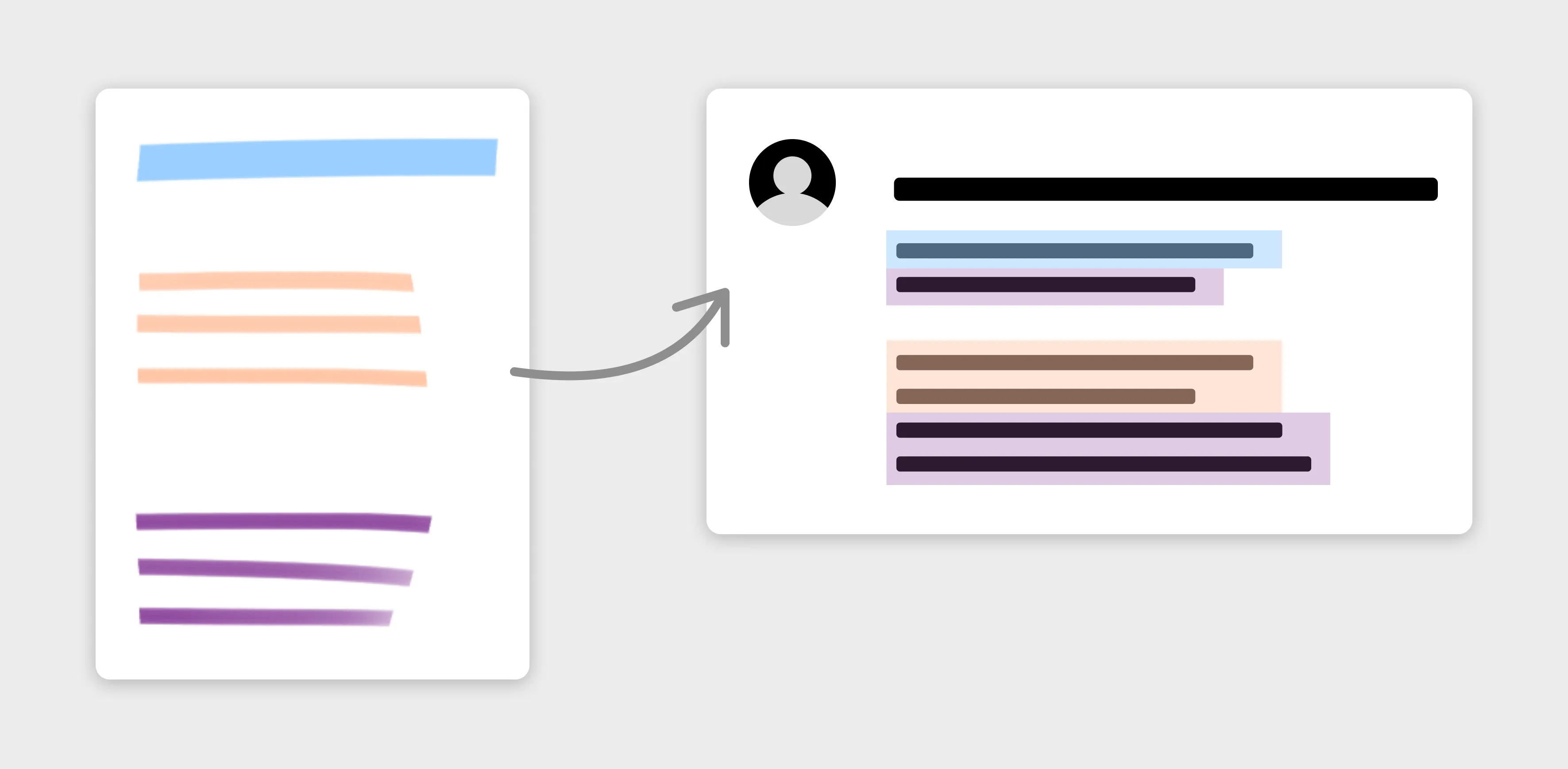
What is Framing
This essay presents a structured approach and exercise for Framing your professional experience , an approach I’ve used to shape my written presentation when applying for jobs in the past few years.
Framing is an exercise to come up with a presentation strategy for yourself as a candidate, so you can highlight relevant work experiences and skills on each job you apply for.
Practically speaking, the goal is to come out well-optimized job assets that you can quickly adjust depending on the job, such as:
- Your resume and cover letters
- Your portfolio copy
- Your LinkedIn job history
Broadly speaking, the goal is to define a clear communication strategy that represents your career goals today and helps you pitch your personal value proposition as a candidate A lot of the thinking behind this comes from [Positioning](https://en.wikipedia.org/wiki/Positioning_(marketing)), a classic concept in advertising, and in many ways the foundation of modern marketing. Highly recommend digging into this if you're interested! .
This process has also helped structure my interview prep. Over the years, I’ve used it as guide to present myself as a more relevant (and more confident) candidate during interviews.
Ultimately, your framing will be the glue that will help a recruiter make sense of your experience.
Your goal is to show companies you apply for how your background is relevant , why your skills are a match for the role , and what’s the angle that makes you unique.
Playing ball in a bad market
Like everyone else, I struggled to change jobs in recent years. Especially in the last 3 years, interviewing as a designer has felt like tossing a coin into a void and hoping for the best.
However, no matter how random and frustrating it feels, job hunting from a candidate’s perspective is a funnel — and hell, every funnel can be optimized, even a bad one.
If you’re trying over and over, and you’re not getting the answers you want… is there a chance you’re not asking the right questions?
Which companies or roles are more suited for your current experience? Which types of job openings do you see more of? Which ones did you get a response from? Where did you progress the furthest? What indirect feedback did you gain from the interview process? Is there a viable job market for your level of experience where you live?Applying a critical and iterative mindset to each job application is fundamental to direct you towards the jobs you can land today . Some of those might seem less than ideal, but they are the steps that will prepare you for the jobs you want in the future .
Every job is a stepping stone if you keep aiming higher.I’ve been in rough spots before. If the only job you manage to land right now isn’t great, then absolutely take that check. But keep aiming higher, and refuse to settle.
And if you needed a push, I hope the advice in this article can do just that! I hope it’s a helpful resource in your job hunt, and if you have feedback, drop me a comment on Bluesky.
Start by looking back
To frame your experience, start by looking back at your personal and professional history: more than just listing past roles and formal education, take note of side-projects, artistic pursuits, and informal training.
📌 Take 5-10 minutes to write down a timeline of your personal and professional history, taking note of interesting life experiences that had a meaningful impact on your career.
Doing this on paper is helpful since you can take space, draw and annotate the timeline any way you want. But really, anything works: a google doc, figma, miro board, etc.
Once you’re done, try presenting your timeline to a friend or colleague. It can be a good way to get feedback on the parts they find especially relevant, and their thoughts on your presentation in general.
I learned this technique on a workshop by Abby Covert a long time ago. Check out her deck for more details and examples of the timeline!
When writing these down, it’s important to keep an open mind, and really consider the experiences that informed your current path. Not every aspect of your story will be relevant in your CV or portfolio, but some can definitely be a part of your professional presentation.
This is especially relevant for people that did not have a formal design education or are coming into a design career from a different industry: our knowledge and expertise shape our form of thinking in ways we don’t fully realize. In the right settings, your unique experiences will be an advantage, and something you can use to highlight your profile.
Candidates with varied backgrounds frequently call my attention when I’m interviewing. It’s especially interesting when a candidate can explain how their background specifically contributes to the way they approach design.
For me, seeing how a person thinks is one of the most rewarding aspects of being an interviewer for design roles. It’s a privilege to see people show a part of their story, and their approach as professional designers.
Preparing your pitch
With your timeline in hands, it’s now time to list out all the parts that might show up in your professional presentation:
- Your most recent jobs or roles
- Your most recent projects
- Your recent education, formal or otherwise
- Your areas of interest or skills (could be anything from user research, to photography — ideally, pick something at least tangentially related to the role)
Out of this list and your timeline, which parts most strongly inform your work as a designer today? Which ones are most important to you, and why? Mark a few that you consider highlights, and that paint a good picture of who you are as a professional today.
Try writing a sentence or two expanding each highlight: doing so can help you better present these experiences when the time comes.
< This could take an example or two >
Using all the points you explored so far, write a short pitch of yourself as a professional.
A good pitch will comprise of 3-5 sentences that tell about your current role and recent experience, but also display your unique qualities and advantages as a designer.
The content in your pitch should be able to respond to the question: “tell me about your experience as a designer”. This is a question you will hear in almost every single interview, in one way or another.
In the next section, I’ll show how to edit and adjust your pitch to use it across different formats: your CV, portfolio, interviews, etc.
Here’s a version of my pitch — this is similar to the ones I’ve used when interviewing the last couple of years:
I’m a product designer building platforms and systems for the web in last 12 years. I am currently living in The Netherlands, and working at GitHub.
Right now I’m designing onboarding and learning experiences at GitHub, supporting developers to start adopting GitHub Copilot and finding new ways it can help them do more — regardless if they are experienced developers or just learning how to code.
Before GitHub, I lead design on the Miro developer platform, re-designed the deployments product for GitLab, and built internal tools at Booking.com
I’m interested in working with complex technical domains that enable developers to do more and unlock product growth.
Two things you can notice about this pitch:
It’s made to be modular, and I can replace pieces of it depending on which kind of role I would be applying for.
It also leverages my previous experience on developer tools, which is very specific to my career path, and a beat I’ve worked on for the last few years.
However, let’s say I was applying to a role where developer experience is not a huge plus — instead, having cross-platform design experience is more important.
I’m not super experienced with mobile app design, but I’ve done my fair share of responsive design, so this is how I would frame my experience instead:
I’m a designer designing products for web and mobile in the last 12 years. I am currently living in The Netherlands, and working at GitHub.
Right now I’m designing onboarding and learning experiences at GitHub across platforms, ensuring our developers have a world-class experience no matter which device they’re in. Before, I designed for an array of products such as Miro, GitLab and Booking.com.
In my time at Booking.com, I lead design for their new Rewards feature, working on interfaces across all of their consumer platforms: web, mobile, native apps — and even emails.
Everything listed above is true of course. I’m just zooming-in on past projects that better match what I read in the job description.
Notably, this cross-platform project at Booking.com happened way back in 2018 and I’m really not super confident with my experience designing native apps today — but hey, if you need that job, then dress for that job.
Once you’re in the (interview) room, how you present your projects and process tends to matter more than any specific set of design skills, and although native app design can be quite unique, it’s possible other qualities could make up for any shortcomings.
If we were to generalize the structure of the examples above, here’s how we could do it:
Current job title and what I do in general. Where I’m working at, and which city I’m based on.
Current role in more detail / what’s my team / what I focus on. Possibly an overview of projects or my process, overall goals of the team / product.
Similarly for previous role: who I collaborated with, some of my design process, goals and/or accomplishments.
List relevant skills for this role and how I displayed them in previous project / Additional sentence to highlight what you’re interested in
Being concise is important when interviewing, but I try to keep my pitch pretty broad / complete, and scale it down for the relevant context.
Don’t be afraid to create shorter versions depending on the role you’re applying for: maybe this role doesn’t have a lot to do with marketing, so you could drop the reference to your previous brand designer role; perhaps designers don’t code on this other role, so you don’t need to mention that at all.
Your complete pitch will then serve as a “base” for you to adjust and use across different roles, presentations and interviews, making sure you present your best self in every scenario.
I’ve used Notion for a long time to prepare for job hunting — it’s a great tool for organizing different applications and honing your pitch.
< Screenshot of Notion >
You can use this Notion space as a template to get started!
Practical Applications
Resume / CV
< Examples of Pitch being >
Cover Letter
Portfolio
Defining your angle
An angle is similar to a pitch, but more compact: a single sentence where you show what you bring to the table.
It’s all about finding that one sentence that can help uniquely describe why your experience is great for this role.
Below are a few examples I used in the past:
I’m passionate about solving real problems for real people: understanding their needs through research, collaborating with my team to define a vision, and designing systems that enable people to do more.
I’m interested in owning an entire technical domain and solving hard problems for professional users
I’m driven by design work that combines complex technical domains with understanding the reality of users, building products that allow them to get stuff done and move on with their lives.
I’ve used some of these examples as part of my base pitch, others were used in cover letters or application questions, and one of them is part of my current LinkedIn description.
You can see they are fairly specific in language:
- “…design work that combines complex technical domains …”
- “…solving hard problems for professional users”
- “…collaborating with my team to define a vision, and designing systems that enable people to do more”
This was meant to tailor the framing to the specific roles I was applying for at the time, and to avoid phrases that were too generic and might dilute the impact of the message:
- “I design to solve problems”
- “I focus on having a user-centered design process”
- “I’m a multi-disciplinary designer”
There’s nothing inherently wrong with the sentences and terms above. They describe qualities a good product designer will have, but the thing is — these are generic enough to describe most good product designers.
To avoid blending in, try to find the specific kind of work you’re excited about in a company, or the specific way you applied your design process in the past, and make that a part of your angle.
It might seem like it’s not the case, but enthusiasm can go a long way when finding differentiators between candidates.
Frequently when discussing candidates, hiring managers will informally use short-hand to refer to people they’ve talked to like “that designer who was really good with motion” or “that one that was great at research”.
A note on writing your copy with AI
Like the rest of this article, this is a very personal opinion, so I will put it very bluntly:
AI chatbots (LLMs) are terrible at writing copy that sounds unique. By default, their output is incredibly bland and verbose, making your text sound pretentious in a way that is not super hard to catch, unless you edit it very intentionally.
Using LLMs to bounce ideas around, get a read on your material or create an outline is not bad at all, but… the current reality of tech hiring is that every good role will receive hundred (if not thousands) of applications, a lot of them written with AI tools.
If your goal is to come up with a professional positioning for yourself that sounds unique in a way that helps you get hired, using a chatbot to write your copy will give off the same vibe that everyone else has — and might just make you blend into the pile.
Ultimately, use them to the extent that you find them useful: if they speed you up and you like the output, then go for it! But keep this advice in mind, and at least edit heavily before you’re done.
Closing notes
While the “tell me about your experience as a designer” question might be repeated multiple times during a hiring process, it is most important on the initial steps.
As you advance and the interviewing team gets to know you, they will be more interested in the specifics of your work and projects than your overall trajectory.
Every interviewer talking to you (hopefully) has also looked at your CV, LinkedIn and portfolio. When they ask you to describe your career trajectory, list your past roles of course, but remember that’s also stuff they can read elsewhere.
This is the moment to sell them on your Framing, your story, and your value as a candidate. That’s why the Pitch and the Angle are useful tools, to help you structure these conversations to land a great impression.
More than just trying to know who you are as a designer, they’re looking for information that confirms that you’re the right designer for that role.
To wrap, here’s a recap of the different things we discussed:
- Framing
- Pitch
- Angle
And links:
- Notion template for preparing your pitch
- Cover letter template
This post is dedicated to the memory of Ben Tregoing, whom we lost in 2024.
Ben was a mentor early in my career in 2014, and albeit our exchange was brief, I’ve carried his kindness and earnest advice with me to this day. We crossed paths again early last year, and our conversations helped shape the thinking behind this article.
I hope this article is able to help others in the same way he did for so many people across his career. You’ll be missed, Ben.